Rowing On with a Shameful Past in Your Arms — 'The Odyssey'
I saw Christopher Nolan's new film 'The Odyssey' on opening day. An immersion so complete it rendered my old habit of dissecting a director's every device meaningless — and the questions that Odysseus's shame and homecoming, three thousand years old, still pose to us today. A record of the first time I couldn't bring myself to leave as the credits rolled.
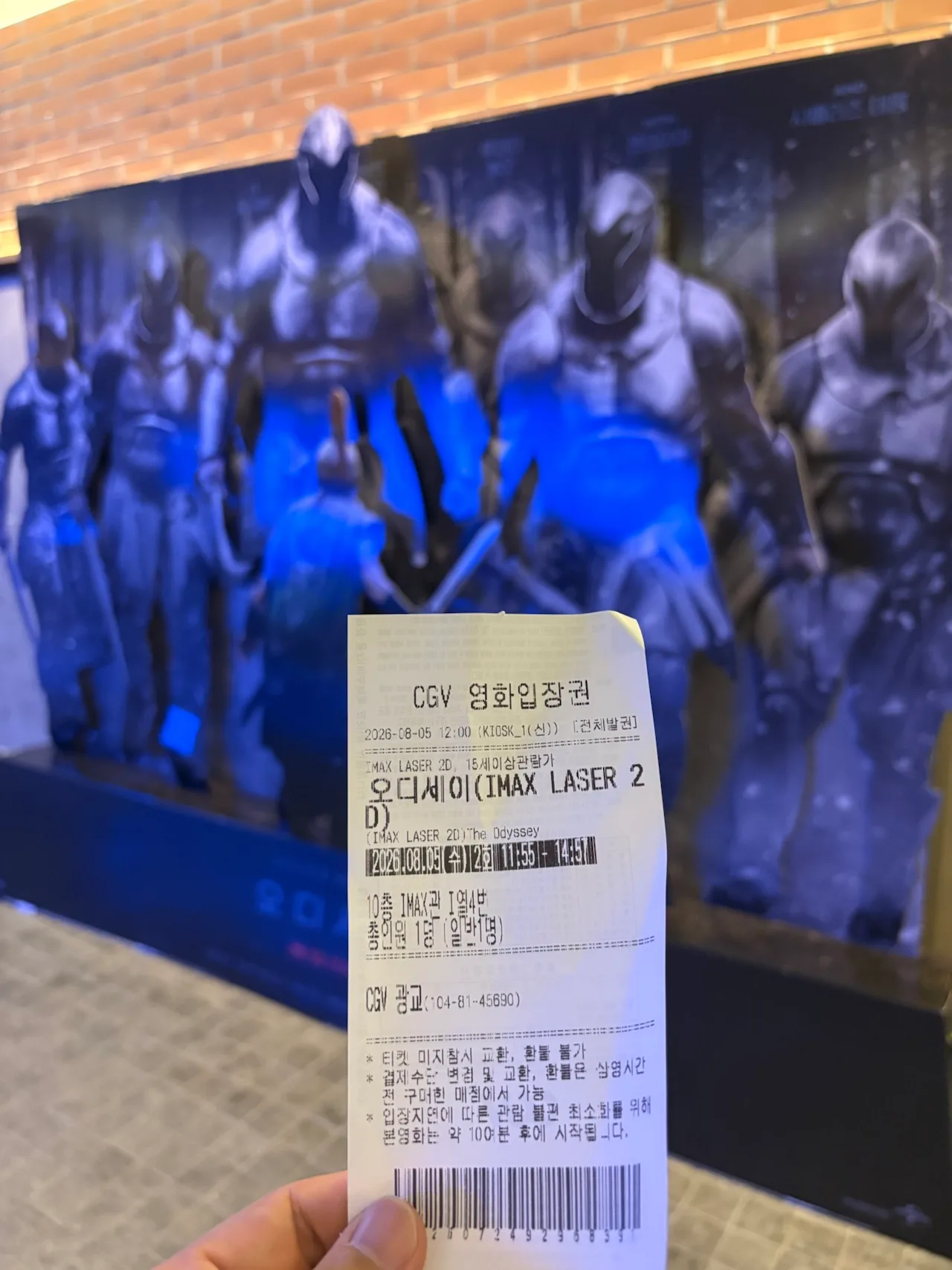
I went to see Christopher Nolan's new film, The Odyssey — on opening day. Nolan sits at the very top of the list of working Hollywood directors. He's a director who catches both hares at once — the aesthetics and the sheer fun of a movie — so I went on day one, trusting that whatever form his work took, it would not disappoint. Watching the theater fill to near capacity on a weekday afternoon, I thought: so there are plenty of people like me.

So they hand out gifts like this on opening day!
The Odyssey, I'm told, is a classic among classics in the West, widely taught in schools. But ignorant of Greek and Roman mythology as I am, I had so little background that I was looking up what the Odyssey was even about in the elevator on my way into the theater. I didn't know the plot; if I knew anything at all, it was that there had been a 'PC controversy' over a Black actress being cast as Helen, famed as a blonde beauty?
A Viewer Who Won't Even Watch Trailers
But then, I'm someone who avoids even trailers before seeing a film. I like to be transported completely into that world while the movie plays. For the entire running time I want to remain purely a spectator — I don't want to watch from the outside world. And unless it's a sequel, I don't much care for films that require prior knowledge to be properly understood. It's a joy to simply follow what my eyes see and my ears hear, inside the frame the director has set, fully absorbed in the actors' performances.
The Moment Analysis Becomes Meaningless
Most of us go to the movies hoping to meet something in particular there. Beautiful cinematography, the pleasure of following the protagonist's story, the immersion of being carried back to another era, the foreshadowing threaded through the plot, and so on. Depending on how you approach film, everyone has their own priorities. In my case, I rather enjoy watching analytically — zeroing in on the director's every device, guessing at their intent.
But watching this film, there was no room for any of that. Before all those scenes, analysis simply lost its meaning. My whole body curled up when the man-eating giants gave chase, and through every step of the journey until Odysseus meets Penelope again, I felt as if I were traveling alongside him. The story was utterly gripping, and every scene seized both eye and ear. When the credits began to roll and I found myself not wanting to rise from my seat — that was a first. It was as if I had become Odysseus of three thousand years ago, wandered those twenty years with him, and only then returned to the theater of the real world.

To think they actually shot nearly all of this for real... Seeing the result, none of that effort was wasted.
The Shame of a War Hero
The heart of Odysseus stayed with me all day. His private anguish didn't feel so distant, like some legend from a faraway past. We, too, live inside a logic of power where promises between people are casually broken, and other people's daily lives are trampled along the way. In the film, some call him a war hero — but Odysseus, who rose by breaking promises and trampling others, must have felt it all to be shameful, and endlessly meaningless.
And yet, throughout the film, we stay beside a man who tries not to repeat the same mistakes, who accepts his human flaws and keeps moving forward. What would I have done? In that moment, could I have embraced the whole of a past I longed to erase, left the happy days with Calypso behind, and stood up? To accept my own past exactly as it is, and not repeat the same mistakes — that was the lesson this film left me.

You can't help but be drawn into Matt Damon's portrayal of Odysseus's anguish.
Meeting the Film of My Life
After leaving the theater, I looked up some reviews. There was talk of historical-accuracy issues, criticism that the actors' dialogue felt too modern, and complaints that the sound was so loud it drowned out the lines. Fortunately, this is a story of an antiquity far removed from us, and for someone like me watching with subtitles, those flaws didn't weigh much. Flaws there may be, but this was a superbly made film. Quite a few people were saying it would become Nolan's finest work. I agree. This film is genuinely, exceptionally well made. To say no more: for me, it is the best film.
Nolan showed once again why he is counted among Hollywood's greatest directors. This film of a legend handed down from long ago breaks out of its past among the gods and throws something worth thinking about to those of us living in the present. The emotion The Odyssey gave me feels like it will circle me for a long, long time.